

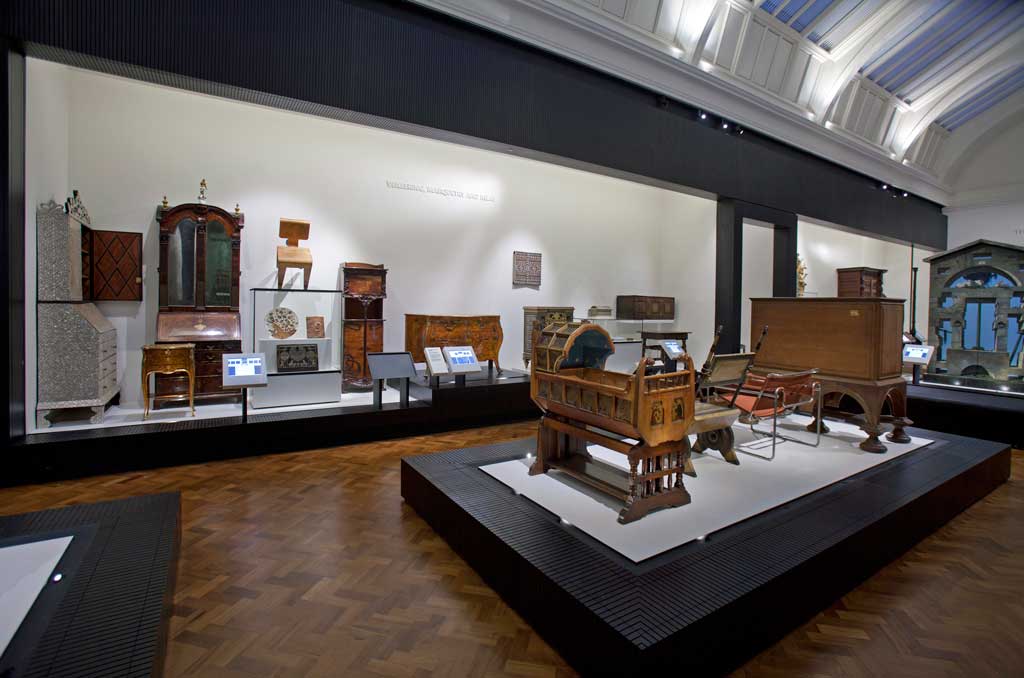

London’s Victoria and Albert Museum (V&A) has long been recognised as one of the world’s leading museums of art and design. December saw the opening of the museum’s first permanent furniture gallery, the Dr Susan Weber Gallery, which offers an in-depth exploration of furniture design and construction over six centuries. Hospitality Interiors’ Katie Sherry speaks to the gallery’s co-curator, Nick Humphrey, to find out more …
Furniture has featured prominently in the V&A’s collection since the museum was founded in the mid-19th century, with many pieces currently on display throughout the 20th Century, Medieval & Renaissance Galleries and British Galleries.
“It had been an ambition of many years standing to create a gallery solely devoted to Western furniture,” Nick says, “and that’s now been possible through FuturePlan and through the generosity of Dr Susan Weber to support the project.”
FuturePlan is an initiative set up by the V&A to restore and redesign the museum through new galleries and redisplays of its collections. Previously a ceramics study gallery, the Dr Susan Weber Gallery has come into being thanks to the redisplay and rationalisation of the existing ceramics galleries over the last five years.
Designed by NORD Architecture, the gallery has a long, narrow layout. The space’s bold and unified black-and-white palette accentuates the many materials used in the 200 pieces on display, which date from the 14th century to the present.
“There’s no substitute for people coming to see the real thing, and in this gallery people will be very close to the 200 pieces that we’re showing”
Nick Humphrey, co-curator of the V&A’s new furniture gallery
Curators Nick Humphrey and Leela Meinertas were keen for the display to emphasise the history of furniture construction and design. “We decided to organise the space into 16 displays, each one looking at a specific technique of construction or decoration and upholstery in furniture,” Nick explains.
The exhibition explores a range of techniques, including joinery and cabinetmaking, carving, turning and digital manufacture. Furthermore, individual displays explore decorative techniques, such as lacquering, japanning, painting and gilding.
“We were also very keen to get a good range of pieces in terms of geography and chronology,” Nick says. “Every display juxtaposes pieces from different centuries purposefully, and one of the most exciting things about seeing the gallery come to life around us is to have a piece from the 15th century cheek-by-jowl with a 20th century piece – both made using the same essential approach to materials, but coming up with an utterly different result.”
Highlighting the progression of furniture design throughout history, 25 major pieces of furniture have been arranged chronologically on island plinths along the centre of the space. The display includes a 17th century cabinet, an 18th century commode, an imposing 19th century sofa constructed by John Henry Belter, and a range of pieces from the 20th century.
“I think that one of the themes that comes out of this display is that there hasn’t been a simple progression from primitive to sophisticated,” Nick says. “It’s not simply that early furniture was crude, dug-out chests, and that we’ve ended up with digital manufacture.”
Although Nick acknowledges that there were some fundamental technological breakthroughs in the production of furniture – such as the use of finer saws to cut veneers in the 16th century and the arrival of plastics in the 20th century – he argues that makers have often returned to traditional methods in their work. “Almost all of the techniques that we are looking at in the gallery were practised in some form in ancient Egypt – as incredible as that seems,” he says.
Nick also argues that styles of furniture, as well as being a result of periodic fashions, were implemented owing to practical means. He cites David Roentgen, a renowned 18th century cabinetmaker known for his ornate marquetry and advanced mechanical fittings, as an example.
“David Roentgen’s furniture, which is arguably some of the finest ever made, was possible to make because of the training and the craftsmen he built up in his workshop – and also because he had clients who were willing to pay astronomical sums. Without those clients, the furniture would never have been made.”
The gallery has a wide range of distinctive pieces on display, including a storage cabinet by Charles and Ray Eames, a cupboard designed by Robert Adams for Croome Court in Worcestershire, and a cradle by Richard Norman Shaw. A selection of Nick’s favourite pieces include a gilded cassone, which retains almost all of its original gesso decoration and paintwork, and a medieval book desk, which has not been on display in living memory.
“There hasn’t been a simple progression from primitive to sophisticated. It’s not simply that early furniture was crude, dug-out chests, and that we’ve ended up with digital manufacture”
Nick Humphrey
Seven mini displays offer an insight into the careers of eight influential designers, which, according to Nick, “punctuate the making displays with the more human stories behind the furniture”. The displays feature profiles of some renowned names, including Thomas Chippendale, the Roentgens and Frank Lloyd Wright.
Less well-known designers are also featured, such as George Brookshaw, a decorative painter working from the end of the 18th century. A profile on David Kirkness, an Orkney chair designer and maker working in approximately 1880-1930, is also included.
A range of interactive technologies throughout the exhibition add an extra dimension to the visitor experience. For the first time in one of the V&A’s permanent galleries, digital labels have been used, giving access to additional information, as well as high quality images from different angles, original designs and inscriptions.
“It’s almost as though you have your own curator or conservator who knows the piece inside-out, right at your shoulder, being able to point out those interesting little details that you might otherwise overlook,” Nick explains.
Audio podcasts at the designer mini displays provide commentary from several experts, including architect David Adjaye and interior designer Laurence Llewelyn-Bowen. In addition, a range of films will explain elements of furniture construction, from how boulle marquetry is made to the way in which an injection-moulded plastic chair is created.
Visitors will also be invited to handle samples of different materials used in furniture, such as hardwoods, turtle-shell, rattan or cast iron. The two interactive tables feature digital screens, which provide further information about how specific materials are sourced, their advantages and disadvantages, and links to pieces in the gallery that exemplify the material.
“In the museum over the last 10 years, we’ve used different kinds of technologies in all our new galleries,” Nick says. “We’ve seen through observation and audience research that it does make a huge difference to the experience of people in the museum – they spend longer and they certainly feel as though they’ve got a great deal more out of their visit.
“However, there’s no substitute for people coming to see the real thing, and in this gallery people will be very close to the 200 pieces that we’re showing. I think the different kinds of interpretation can provide an additional dimension, but fundamentally, as a curator, there’s no substitute for having the real thing in front of you.”