

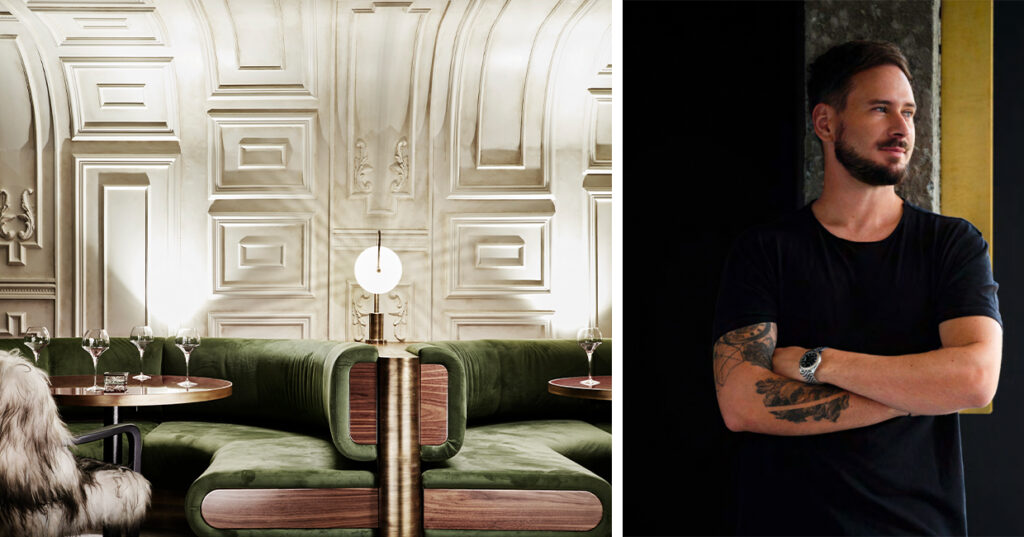

Tristan Du Plessis, founder of the self-titled, international award-winning interior architectural studio based in Cape Town, South Africa, talks to Hospitality Interiors’ Can Faik about the importance of authenticity, and ensuring design projects are successful for the long-term …
Tell us a little bit about yourself …
I’m a Joburger, which is the nickname for South Africans that come from Johannesburg. I’ve always been interested in design, but I actually went to university thinking of studying marketing. Luckily, I realised within a short period of time that it wasn’t for me.
What three words would you use to describe Tristan Du Plessis Studio?
Collaboratve, contemporary, distinctive.
How would you describe your style?
Masculine luxury would encapsulate my style best, even in incredibly light spaces like SAN Beach Club Dubai (one of my latest projects). Through the lines, shapes and fabrics you get a touch of masculinity that is a common thread in my design.
With so many designers in the industry, how does Tristan Du Plessis Studio stand out?
I love that there is such diversity in the industry. I see it as an incredible way for clients to connect with the right designers for each project. For us, it’s about collaborating onprojects that interest us and that have the creative leeway to showcase our skillset and to shape the hospitality industry in a small way.
How can design be used to manage the guest’s expectation of the hotel experience?
The key driver for managing guests’ expectations through design is functionality. While a space can be beautiful, if it doesn’t serve the right purpose in this context it can negatively impact a guest. I also think giving the guests unexpected touches in terms of design – be it through elegantly tucked-away features or functional art – is an easy way to surpass expectations. I feel that beyond that, the journey through a hotel should be cinematic, and that all designers should use this lens to create beautiful moments that aren’t experienced in the everyday.
How do you approach each project in order to give the guest an authentic experience?
At the heart of each project is understanding the client’s holistic creative vision. I get to understand that on every level, and then I seek inspiration from the outside world, be it through travel, books, or film. I live and breathe hospitality, and travel more than 50% of my year, so I have deep knowledge of the guest experience and constantly stumble upon new ideas to improve the guest experience and, especially, how it relates to the local context.
How high on the list is revenue creation for designers?
The commercial success of each project is so important to me as a designer. These projects are huge financial undertakings, and seeing our projects flourish and our clients happy brings me immense pride. I feel that the commercial side of the project is important, and that good design and high- quality execution is absolutely vital in creating a strong product in the marketplace that can stand the test of time and be successful in the long term.
What are your thoughts on social media and the role it plays as a marketing tool for hotels? Do you take it into account when designing spaces?
Social media is brilliant in terms of democratising access to great design, from discovering hotels across the globe to highlighting young design talent. Ultimately, social media is a heightened manifestation of connected media that has existed for years, so we don’t put it at the forefront of our design – it will change over time, and we look at design from an experiential perspective that will transcend Instagram today and its next incarnation tomorrow. I feel that one shouldn’t design features with the goal being that it should be photographed for Instagram, but rather that one should create such a beautifulexperience that people naturally want to share it with the world.
How do you think the influence of new technology affects the luxury traveller, and will do so in the future?
New technology has taken away a significant amount of friction from the luxury traveller’s experience, and as the industry continues to innovate it will continue to become even more seamless. The design challenge comes in making sure that the overall feel and aesthetic you set out to achieve isn’t compromised while trying to incorporate technology.
Do you believe simple design has become luxurious?
Simplicity within the luxury design space means that the limited materials used must be beautiful and impactful. I feel that the beauty of authentic materiality is truly what is admired in these simpler designs. Minimal spaces
also feel more calming and peaceful – I feel that this is a new desire within the market. I personally crave calm, minimal spaces that quiet the mind, especially when travelling.
What particular trends have you noticed in hotel interior design?
I have noticed a definite shift towards wellness and health within the luxury market. I also feel that there is a trend towards creating fully immersive brand experiences where each detail, product and treatment is considered as part of the greater hotel narrative. I also feel that luxury hotel design is engaging a much broader market and is moving swiftly away from the previously expected rigid – and sometimes imposing – luxury design of previous years.
Do you think there is a difference in tone and texture between ideas of hospitality in Africa and Europe?
The interconnectedness of how we travel has created a universality in the experience. However, in Africa hospitality is definitely driven by ‘ubuntu’ – loosely translated, meaning a spirit of togetherness – so you feel a sense
of belonging, and with Europe there’s a focus on really creating a unique experience. From Croatia to London, it’s an exciting and tangible difference.
What does design mean to you?
I feel that certain professions are there to sustain and improve life as we know it. I believe that design exists to keep life worth living. Being able to create memorable spaces within which the happier moments in life happen is truly an honour.
Where do you see hotel design going in the future?
I see the idea of the home bleeding into hotel design more distinctly. While technology will drive a more exciting, future-forward experience, there are soft touches and key spaces within every hotel that will evoke the sense of home you can often lose when you travel.
What are your thoughts on the wellness trend in luxury hotels?
It’s exciting, because spas have always been an afterthought and a simple necessity one includes as part of the luxury experience. But, post-pandemic, the idea that wellness extends far beyond a massage has become popular, and creating spaces that seamlessly integrate the traditional aspects of hotel living with wellness in its different forms is challenging – but also, I think, rewarding.
Are there any particular architects or designers you admire?
Yes of course, designers like Christian Liaigre, Joseph Dirand and Tristan Auer have been such an inspiration to me, even though my style is completely different to theirs.
Is there anything exciting you’re working on that you can tell us about?
I am working on two luxury hotels for Accor in the Middle East, a beautiful boutique country resort in Tuscany and two F&B projects in Miami – all of which I am very excited to be working on.
What’s next for you and Tristan Du Plessis Studio?
It’s been an incredible period of growth and we are looking at developing even more projects across the globe, from the UAE to the US and Europe. I’m also looking forward to stretching my creative muscles with more collaborations in different creative spheres.