


Characterised by its brilliant white façade, majestic three-storey arches and recessed windows, the original Murray Building was designed by British modernist architect, Ron Phillips, in 1969. The emblematic structure was perceived as an early exemplar of sustainable and energy efficient design, echoed by its location between Hong Kong Park and the Botanical Gardens.
Led by Foster + Partners‘ Colin Ward in Hong Kong and Armstrong Yakubu in London, the new design honours the integrity of the structure, while meeting with the needs of sophisticated contemporary living and discerning global travellers.
“With the Murray Building – an outstanding example of 1970s Hong Kong architecture – we have been able to reconnect an important civic landmark with the city,” says Luke Fox, senior executive partner and head of studio, Foster + Partners.
“This project draws on key areas of our expertise in urbanism, architecture and interiors, and our design will breathe new life into this classic Hong Kong building by creating a unique hotel and leisure destination for international visitors and locals to enjoy.”
“With the Murray Building – an outstanding example of 1970s Hong Kong architecture – we have been able to reconnect an important civic landmark with the city”
Creating an impactful sense of arrival, a private forecourt with an historic cotton tree at its centre acts as the hotel’s drop-off and entrance.
“If there is one element that unifies the most successful hotels in the world, it would be the grand arrival sequence,” says Armstrong Yakubu. “While The Murray owns its driveway, it is the arches at the base of the hotel that symbolise the welcoming nature of the building, stitching together this part of the city with amazing new public spaces for the people of Hong Kong and visitors from across the world.
“But it would be remiss of me not to mention the heritage tree that Cotton Tree Drive derives its name from, which forms the central focus of the arrival sequence through the hotel. The arches frame the magnificent old cotton tree as guests drive up to the drop-off, creating a memorable and unique experience for all.”
After passing through this impressive entrance, the lobby features a graceful staircase leading to the Garden Level with its elegant lounge and restaurant space. Eight large lifts take guests to the accommodation on the upper floors.
Foster + Partners stripped the building back to its original form, reinstating its clean clines and embracing the building’s geometry to create uniquely oriented room layouts. In keeping with this, the hotel’s interior features an palette of honest, luxurious materials.
The Murray’s 336 guest rooms and suites are generously sized, with more than 75% at 50 square metres or larger. Foor to ceiling, uniquely recessed windows flood each room with abundant light, while preventiong direct heat from the morning sun.
The hotel’s ‘N1’, ‘N2’ and ‘N3’ rooms are contemporary in style, with seamless technology, beautifully appointed bathrooms and luxurious bath and grooming amenities. Muted, earthy tones abound here, with plush area rugs, beautiful hardwood floors and surfaces adorned with rare stones, leather and textiles to create a sophisticated, urban chic feel.
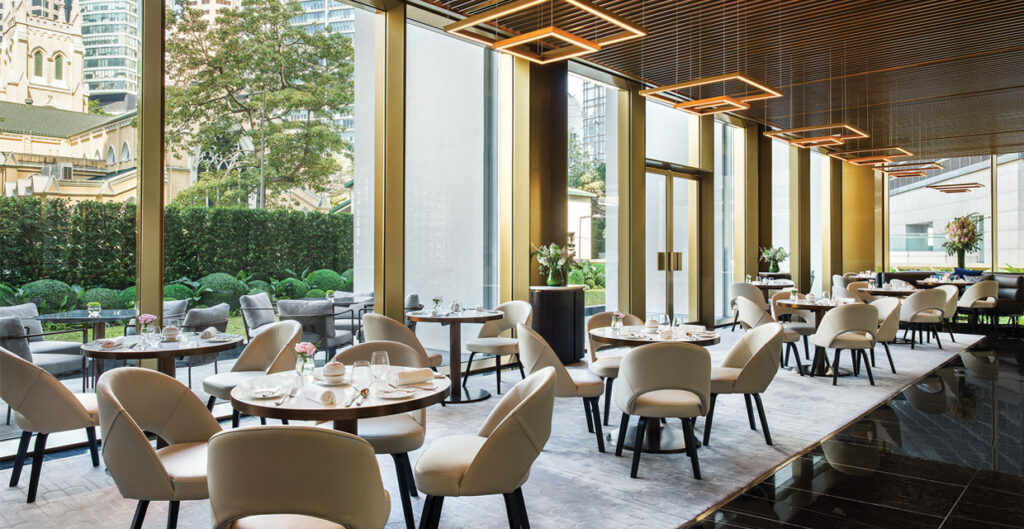
This light, modern feel is mirrored in the hotel’s public spaces which include a vibrant bar, ‘Murray Lane’; the ‘Garden Lounge’, which offers an elegant space in which to enjoy Afternoon Tea; modern-European restaurant, ‘The Tai Pan’; Cantonese restaurant, Guo Fu Lou, and upscale rooftop restaurant, Popinjays.
“The concept was to showcase the inherent beauty of the materials – there are no applied finishes such as paint; all the materials are expressed honestly and come together to redefine luxury”
“The concept was to showcase the inherent beauty of the materials – there are no applied finishes such as paint; all the materials are expressed honestly and come together to redefine luxury,” Armstrong explains.
“To evoke a contemporary aesthetic, white and black marble floors are paired with polished metals and feature a signature ‘bronze’ stainless steel finish. We have also contrasted handmade glass with exquisite fabrics from Italy and Asia, adding an element of craftsmanship to the interior spaces. Each element has been carefully chosen to integrate with the holistic vision of the spaces.”
It was key for Foster + Partners that the property should convey a carefully crafted dialogue between old and new. Though the building retains its unique character, there were several practical elements that needed attention.
“A former government building, the Murray Building had been fenced off from the surrounding areas for many years for security reasons,” explains Colin Ward. “It was also designed at a time when the city was planned around the car and consequently stands on an island site, surrounded by roads making it impermeable for pedestrians.
“One of the central aims of the project was to reconnect the building with the city at ground level, creating a new street frontage on Garden Road, with open routes at ground level. There are transparent and welcoming ground floor spaces, and enhancing and extending the landscaped grounds. The rooftop too has been designed as a transparent glass pavilion on a roof terrace with a bar and café overlooking the city.”
The roof top terrace not only provides a stylish dining destination, but was an artful way of bolstering the building’s visibiliy in Hong Kong’s skyline. Surrounded by much taller buildings, and overlooked by many from quite a distance, the roof terrace has been designed as an eye-catching continuation of the green landscape.
Indeed, Foster + Partners have not only given The Murray a renewed architectural presence, but have ensured that the hotel stands proudly with a strong and distinctive offering.
“We think very few hotels are able to offer a unique experience to their guests, which is the prime focus of the contemporary leisure industry,” explains Armstrong.
“Most new hotels today are buried within mixed-use buildings. The Murray recalls the tradition of the grand hotels and in doing so creates a distinctive presence on Hong Kong Island. It also seeks to redefine the idea of luxury, which is about a generosity of space, and an inherent understanding of how the hotel responds to the needs of the guest.
“We wanted to create an experience that was seamless – from how one travels through the building to the services and finishes, all coming together within a holistic vision for The Murray.”