


I have recently been invited to be a judge at this year’s Sleep event – Europe’s hotel design and development event (21st – 22nd November at Business Design Centre in London) – that has taken as its theme, “Loyalty: Lessons in Love”.
This, along with the completion of the first stage in our renovation of Royal Lancaster London, recently dubbed by The Telegraph as “the most Instagrammable hotel in West London”, has led me to ponder the issue of loyalty within the industry I’ve been a part of for nearly 30 years.
There can be no doubt that choice within the hospitality sector has never been so abundant. That, coupled with the fast-paced, trend-hunting, social-media-driven environment we now find ourselves in, must surely mean that all of us, potential hotel guests, have become more fickle.
What is Loyalty in Hospitality?
As a general definition of loyalty, The Collins Oxford dictionary gives me: steadfastness, dependability, fidelity, reliability, constancy, trustworthiness, allegiance, devotion and faithfulness. But what does it mean in hospitality, a world big on value and experience?
Should we be focusing on guests’ loyalty to a hotel brand (an optimistic ambition with such rich pickings to select from) or is it a question of the hotel’s loyalty to their guests (arguably equally as ambitious in such a fast-changing and transient market)?
“Should we be focusing on guests’ loyalty to a hotel brand (an optimistic ambition with such rich pickings to select from) or is it a question of the hotel’s loyalty to their guests?”
Firstly, I suggest that loyalty is a far more significant issue for upscale, luxury and lifestyle hotels than for budget and mid-scale hotels. The latter are all about function and locations that offer good access to transport and meeting hubs, and are selected on the basis of a combination of corporate accounts, value-for-money, and point of need.
However, take brands such as Ace Hotels or, very different, Four Seasons, and things change. Here, there is an emotional buy-in to a culture and tone of voice, not to mention the individuality of food & beverage venues and the way in which the interior design embraces the locale. This personal, site-specific approach shows that the brand cares about attracting a highly-targeted guest, and in turn means that such a person is confident of feeling at home within the brand’s stable, of being with their own tribe.
How is loyalty created?
It starts, as all great hospitality, with a simple show of respect for the guest – not everyone is a seasoned traveller so understanding and supporting a certain vulnerability and lack of local knowledge in guests who are far from home is important. However, in such a competitive market, this is not enough, and major brands such as Marriott-Starwood, Hilton and Accor have realised they need ‘cradle-to-grave’ products and services that suit their guests’ changing needs and personal evolution.
Another factor is the commercial lifespan of a hotel guestroom interior. It used to be 15 years, then 10, and in recent years, it has dwindled down to just five. Yet with culture changing so fast and the ceaseless introduction of newer and newer technologies, trends and products, even five years is now too long.
Does this mean that hotel designers need to think about interchangeability in their solutions, allowing key features in a room to be transplanted every three years to keep things fresh? Or, as the cost of constant redesign and innovation is impractically high and time-consuming, is there a way to circumvent the actual replacement of tangible items without appearing dated and out of touch with guests?
Enter Social Media. We all know that “Social” holds the power to promote a brand through advertising and links, or through social connectivity and associated recommendations. However, these are not the elements that I’m talking about. Think bigger.
Designing with Social Media
Take Facebook. It is now influencing voters in national elections. The US Presidential candidates have spent inordinate amounts on Facebook data in order to win votes. What if a hotel brand were to buy this powerful data and use it to enhance loyalty?
Social Media can impact our hotel experience profoundly with no need for any change to fit-out lifespan. What if I check-in to my hotel and the front desk already knows I love martini cocktails, arthouse movies, opera, Pilates classes, Indian food and a freshly pressed shirt each day?
Imagine what they could do with that: a small martini list card nestled gently against the desk lamp; a selection of great art-house movies preloaded onto my complimentary in-room tablet; a copy of TimeOut or the local equivalent with a marker on the Arts & Culture section; a link on the TV to a Pilates health channel or a copy of the hotel gym’s class schedule; a personal email with weblinks to the best Indian restaurants in town; and a complimentary voucher for a freshly pressed shirt the next day.
Would I be bowled over and become excited about the opportunities presented to me, or would I feel unnerved? Would I suddenly feel this hotel brand was invading my privacy – something totally at odds with my personal expectation that any good hotel should always protect me through their discretion?
The fact is, however, that Google searches, newsfeeds and online ads are already curated for us as individuals. Whilst some may find this irritating, many either don’t even notice, or have been known to click on a few ads that have struck their fancy.
As a result, traditional values and loyalties are being eroded, and, I suspect, Social Media will increasingly provide the new differential and leverage for particular brands, as without this information, many will struggle to create loyalty. This new frontier could also give us, as designers, the exciting challenge and opportunity to play with new interiors, flexing layout and styling to suit the preferences of individual guests and using the powerful information the hotel has “harvested” as a basis for the design brief.
“The possibilities for tailoring the environment to pre-empt the needs and desires of guests are endless, meaning both designers and operators will have to carefully edit to keep things feasible both for staff and for the budget”
So, thinking ahead to the design of our next fabulous, luxury guestroom interior, we may well need to consider a special place for a beautiful porcelain bowl to hold a selection of a guest’s favourite fruit, or a specifically designed marble postcard holder positioned on the desk to accept a custom-printed card listing this month’s cocktails.
Maybe we will include a shaker and martini glass above the minibar, or a wall shelf to hold the complimentary pre-loaded tablet. At Royal Lancaster London, we were keen to include design elements that would help the operator provide their guests with impeccable and personalised services. This ranged from changing the layout of the lobby to include multiple check-in options, to catering for tech-savvy guests in a hurry as well as those wishing to sit down and be assisted by a dedicated member of staff, and designing beautiful cards for staff to leave handwritten messages in guests’ rooms.
Whether large or small, such design decisions impact the guest experience. The possibilities for tailoring the environment to pre-empt the needs and desires of guests are endless, meaning both designers and operators will have to carefully edit to keep things feasible both for staff and for the budget. Nevertheless, this is an exciting new chapter in the world of loyalty and means that we can start creating truly bespoke experiences that cater to guests’ emotional values.
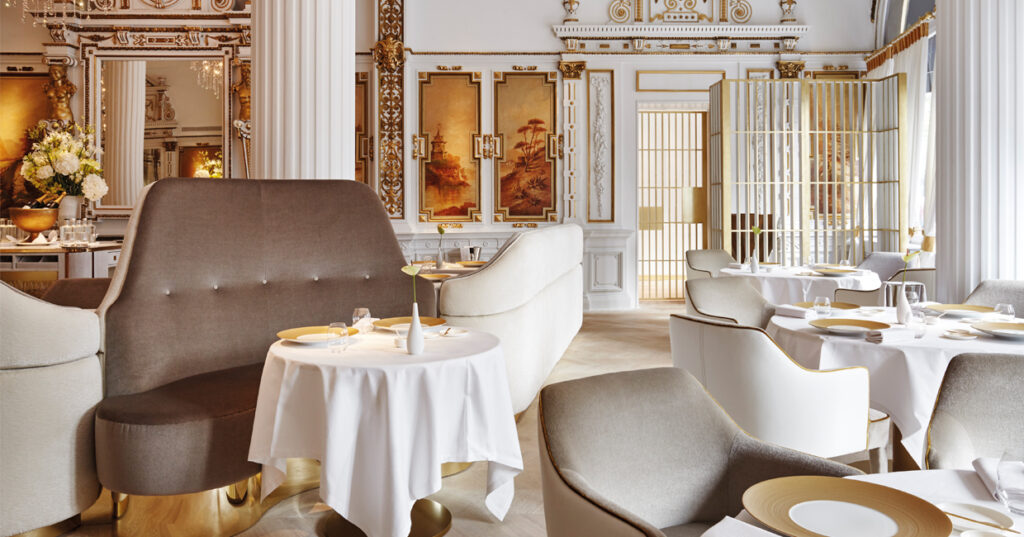
Pictured L-R : Royal Lancaster London – Lounge; David Morris, Creative Director of Studio Proof; Royal Lancaster London – Guestroom; Hotel NH Collection Amsterdam Grand Hotel Krasnapolsky – The White Room