

Close Menu
Hospitality InteriorsHospitality Interiors
  • News
  • Articles
    • Interviews
    • Opening Shots
    • Products
    • Profiles
    • Projects
    • Resources
    • Trends
  • Magazines
    • Issue 123 – Jan/Feb 2026
    • Issue 122 – Nov/Dec 2025
    • Issue 121 – Sept/Oct 2025
    • Issue 120 – July/August 2025
    • Issue 119 – May/June 2025
    • Design Destinations December 2025
    • Design Destinations August 2025
    • Design Destinations: June 2025
    • All Recent Issues
  • Sponsored Content
  • Events
    • Sustainability in Design Awards
  • Email Newsletters
  • About Us
    • Advertise
    • Contact Us
LinkedIn Instagram
Hospitality InteriorsHospitality Interiors
Subscribe to Magazine
  • News
  • Articles
    • Interviews
    • Opening Shots
    • Products
    • Profiles
    • Projects
    • Resources
    • Trends
  • Magazines
    1. Issue 123 – Jan/Feb 2026
    2. Issue 122 – Nov/Dec 2025
    3. Issue 121 – Sept/Oct 2025
    4. Issue 120 – July/August 2025
    5. Issue 119 – May/June 2025
    6. Design Destinations December 2025
    7. Design Destinations August 2025
    8. Design Destinations: June 2025
    9. All Recent Issues
    Featured

    Hospitality Interiors: Issue 123 – January/February 2026

    29 January 2026
    Recent

    Hospitality Interiors: Issue 123 – January/February 2026

    29 January 2026

    Design Destinations: South East Asia Edit 2025

    19 December 2025

    Hospitality Interiors: Issue 122 – November/December 2025

    13 November 2025
  • Sponsored Content
  • Events
    • Sustainability in Design Awards
  • Email Newsletters
  • About Us
    • Advertise
    • Contact Us
LinkedIn Instagram
Subscribe to Magazine
Hospitality InteriorsHospitality Interiors
News

Rights of Future Generations revealed as theme of first Sharjah Architecture Triennial

Katie SherryBy Katie Sherry25 May 20182 Mins Read
Share
Facebook Twitter LinkedIn

Running for three months, the Triennial will open in November 2019 in the Emirate of Sharjah as the first major platform for dialogue on architecture and urbanism focusing on the Middle East, North Africa, East Africa and South Asia.

Emerging as a radical proposal within indigenous struggles and international law, Rights of Future Generations aims to fundamentally challenge the way we think about designing societies and environments with important implications for architecture, urban design, and planning. The exploration of this concept both within the context of the Arabic-speaking world and the global south is at the heart of the inaugural Sharjah Architecture Triennial. 

“Rights of Future Generations is an invitation to radically rethink fundamental questions about architecture and its power to create and sustain alternative modes of existence,” says Adrian Lahoud. “The last decades have seen a massive expansion in rights, yet this expansion has failed to address long-standing challenges around environmental change and inequality.

“A focus on rights to health, education, and housing as individual rights has obscured collective rights such as rights of nature and environmental rights. At the same time, the conceptualisation of rights as basic standards reduces the diversity of human existence to mere subsistence within a universal minimum.

“These deeply-held preconceptions expressed in very basic ideas like shelter continue to inform how we think about architecture as something that protects us from the environment, or as some primordial need that exists irrespective of the existential differences between societies.

“The same is true for concepts like habitat that are deployed in the same way and by the same institutions. This colonial legacy has never ceased informing the kinds of desires and ambitions the discipline and the profession authorizes. Any emancipatory project will have to start with this condition.”

Rights of Future Generations questions how inheritance, legacy, and the state of the environment are passed from one generation to the next, how present decisions have long-term intergenerational consequences, and how other expressions of co-existence, including indigenous ones, might challenge dominant western perspectives.

Turning to alternative concepts of architecture and the environment, the Sharjah Architecture Triennial will focus on moments where experiments with architectural and institutional forms collaborate to generate new social realities.

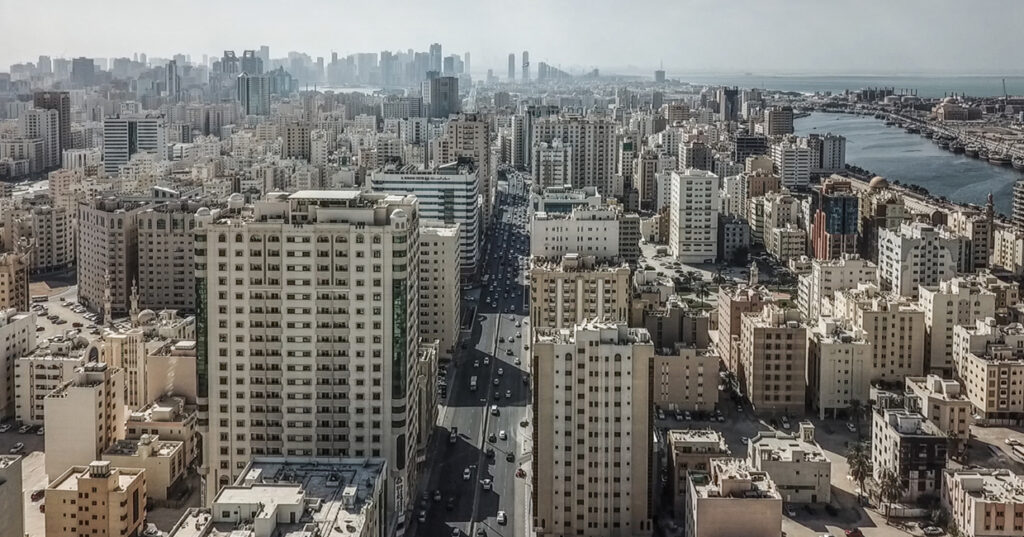
Photograph: Drone image of aerial view from Al Sharq Street overlooking Khalid Port, Sharjah.

Previous ArticleArora Group puts its heart into Wellbeing Week
Next Article Merchants Manor launches two luxury apartments on the Cornish Coast
Katie Sherry

Read Similar Stories

Fifteen New HIMACS Colours for 2026 Bring Depth, Texture and Sustainable Design Choices

27 February 2026

Anantara Downtown Dubai Hotel unveils a New Era of Contemporary Urban Luxury

27 February 2026

IDILIQ Hotels & Resorts Unveils New Openings for 2026

27 February 2026
Latest Content

Fifteen New HIMACS Colours for 2026 Bring Depth, Texture and Sustainable Design Choices

Anantara Downtown Dubai Hotel unveils a New Era of Contemporary Urban Luxury

IDILIQ Hotels & Resorts Unveils New Openings for 2026

Sponsored Content

Fifteen New HIMACS Colours for 2026 Bring Depth, Texture and Sustainable Design Choices

27 February 2026

Signature50: A Classic Wood Floor for Hospitality Spaces That Demand More

11 February 2026
Get in Touch
  • About Us
  • Advertise
  • Contact Us
  • Subscribe
© 2026 Lewis Business Media. All Rights Reserved.
Lewis Business Media, Suite A, Arun House, Office Village, River Way, Uckfield, TN22 1SL

Privacy Policy | Cookie Policy | Terms & Conditions

Type above and press Enter to search. Press Esc to cancel.

Hospitality Interiors
Managing Your Privacy

To provide the best digital experience, we use cookies to store and/or access device information. Consenting to our use of cookies allows us to process data such as reading behaviour. Not consenting or withdrawing consent, may adversely affect certain features and functions.

Functional Always active
The technical storage or access is strictly necessary for the legitimate purpose of enabling the use of a specific service explicitly requested by the subscriber or user, or for the sole purpose of carrying out the transmission of a communication over an electronic communications network.
Preferences
The technical storage or access is necessary for the legitimate purpose of storing preferences that are not requested by the subscriber or user.
Statistics
The technical storage or access that is used exclusively for statistical purposes. The technical storage or access that is used exclusively for anonymous statistical purposes. Without a subpoena, voluntary compliance on the part of your Internet Service Provider, or additional records from a third party, information stored or retrieved for this purpose alone cannot usually be used to identify you.
Marketing
The technical storage or access is required to create user profiles to send advertising, or to track the user on a website or across several websites for similar marketing purposes.
  • Manage options
  • Manage services
  • Manage {vendor_count} vendors
  • Read more about these purposes
Cookie Preferences
  • {title}
  • {title}
  • {title}