

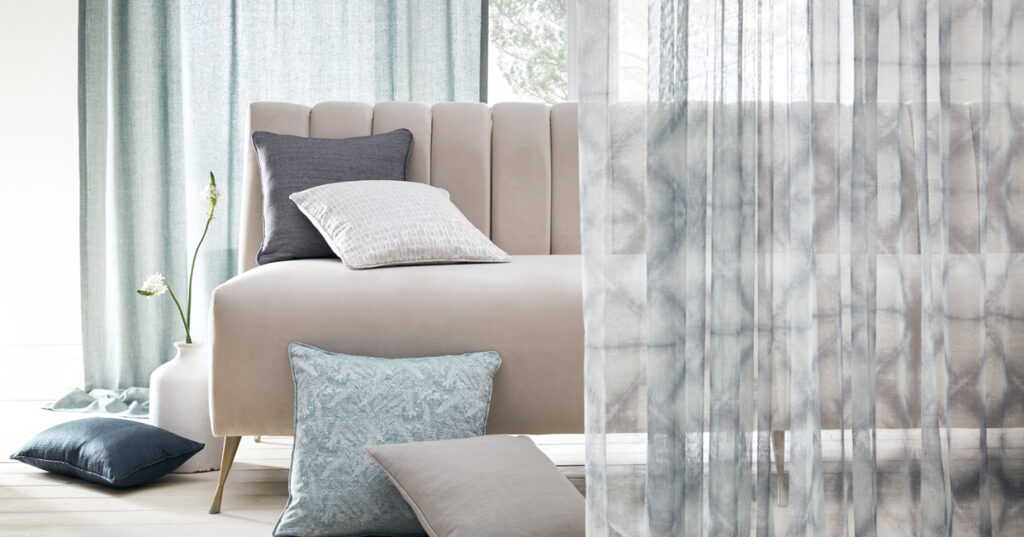

Part of the Sanderson Design Group’s portfolio, Clarke & Clarke’s eclectic offering ranges from sleek, contemporary designs to the decadently glamorous. Here, we speak with Jess Killen, senior textile designer, and Carl Nash, contract sales manager, about the brand’s recent collection, Natura, as well as developments in sustainable textile design and recent hospitality projects …
How would you describe your work and your position within Clarke & Clarke?
JESS KILLEN: Working across a variety of collections over the last five years, for Clarke & Clarke, Studio G and contract services. I’d describe it as fantastically varied, and always changing.
The contemporary textiles industry is constantly changing – what would you describe as the most significant development within the last 5-10 years?
JESS KILLEN: Like the industry itself, all the mills we work with are constantly trialling new techniques and processes. The most exciting developments are evolving around recycling/reusing materials to create new fabrics. For SS21 we unveiled Eco, a collection of classic patterns made entirely from recycled plastic – for us it was about pushing boundaries, both within our brand portfolio and the interiors industry.
CARL NASH: The advancements in digital printing over the last 10 years have transformed the industry. With new technology, we’re now able to leverage a new flexibility for producing bespoke fabric designs at lower costs and with shorter lead times, all the while producing less waste. In addition, the growth in recyclable fabric options are equally important in producing premium collections that are truly sustainable.
Tell us a bit about your typical day?
JESS KILLEN: Each day is so different! Working across different seasons simultaneously means that one day is never the same as the next- it could be developing new artwork at the start of the process or collaborating with stylists on the final photography. I also work hand in hand with the graphics department for final book layouts, so it really is completely varied.
Tell us about your recent collection, Natura.
JESS KILLEN: Natura was born out of a gap we saw in the contracts market for drapery solutions that have a tactile edge and offer a gorgeous, organic feel.
Wanting to move away from flat or shiny products which we see all too often in the hospitality sector, we’ve used linen slub effects with a soft handle. Alongside these, loose weave techniques highlight naturalistic elements. All of this is reinforced with a palette which is soft on the eye and offers a calming atmosphere.
‘Terra’ is a light weight, organic fabric with a linen slub effect and has no shine (like linen) but offers a soft handle. ‘Pura’ on the other hand is a semi-sheer fabric, which has a loose weave effect combined with a hint of a metallic yarn to add a subtle shine. ‘Arva’ is an embossed fabric, enhancing texture. The leaf silhouette of ‘Arbor’ and the soft geometric ‘Vena’ offer easy living shapes found in nature with a colour fade effect woven in the ground. The final design ‘Fuco’ has an organic batik tie-dye print, bold in scale but painted so the colour fades, softening the print.
What fabrics/colours have you used to create the recent collection?
JESS KILLEN: Softening the palette helped us create the relaxed look we wanted. We were also inspired by delicate mineral tones, for a pared back and organic feeling that is timeless and modern.
What is your favourite piece from the collection and why?
JESS KILLEN: I really love the fabric ‘Vena’, especially in the blush colourway. It has a simple form and an interesting woven structure in the ground which adds to the soft texture.
What are your biggest bugbears with the interiors industry when it comes to waste?
JESS KILLEN: A really big challenge is reducing waste in the development stage, but we are considerate with all our sampling decisions. Moreover, Sanderson Design Group (SDG) is always trying new ways to keep waste down to a minimum, and is open to new solutions for managing waste, such as through charitable donations.
CARL NASH: Historically, sampling waste has been an issue within the interiors industry. However, with advancements in digital platforms and a more targeted approach to sampling, the situation is improving.
From a design perspective, how does the family of Clarke & Clarke products fit with the modern hospitality market?
JESS KILLEN: We see ourselves as offering the biggest variety of choices in the premium interiors market. From bright and glamorous, to fresh, organic looks like in Natura, Clarke & Clarke has a unique variety.
CARL NASH: Also, the brand combines quality and performance along with fantastic value for money, so it is perfect for projects of every shape and size.
What notable hospitality projects has Clarke & Clarke been involved with recently?
CARL NASH: Recently with the Lausanne Palace Hotel who used Emma J Shipley for Clarke and Clarke ‘Wilderie’ collection. Fantastical, striking and imaginative, it’s great to see this inspiring collection in such a prestigious setting.
Over the last 12 months, we’ve been involved in various hospitality projects including The Queens Hotel, Leeds, The Westin Hotel, London, Le Meridian in the United Arab Emirates, Mandarin Oriental Hotel in Munich, and several Stay City and Hilton sites in the UK & Eire. It’s been a real thrill to see our collections in historically prestigious locations, as well as in sleek, cutting-edge sites.
What do you see as the key challenges facing the textile industry today?
JESS KILLEN: Creating fabrics in a sustainable way, definitely. With our Eco collection, we’ve shown that premium interior design can cater to the fashion and environmentally conscious market, and it’s about exploring all these avenues and pushing the brief even further.
CARL NASH: The longer-term challenges for our industry are centred around sustainability, without a doubt. A huge part of the challenge is for our customers, as well as the whole industry, to ask what is the best way forward. It’s an issue which impacts the whole process, from design, right up to installation. The questions and ideas for improvement are many; Is it the raw material and where that originates? Is natural fibre more sustainable than synthetic? Is it where the finished product is made? Is the product and packaging recyclable?
A more immediate question concerns how we will all adapt within the post-pandemic world. Utilising webinars is a way of extending our showroom / offline space and we are seeing a great response to digital ways of working.
What have been some of the key developments towards a sustainable future for textiles?
JESS KILLEN: Looking at ways of reducing waste and reusing materials wherever possible, alongside sustainably sourcing those materials in the first place. We’ve seen a consumer trend across our social channels with upcycling which helps reinvent old furniture in new, sustainable ways.
How does your organisation contribute to a cleaner, greener textile industry?
CARL NASH: There is a Group commitment to improved sustainability and a roadmap to substantially reduce our carbon footprint with measurable targets over the next 3 years and beyond. Within Clarke & Clarke, we’re committed to investigating sustainable production techniques, such as reducing waste, but also reframing the issue of how we design collections in the first instance.
How would you explain, to a non-expert, the process that makes this fabric fire retardant?
JESS KILLEN: All of the fabrics are inherent FR which means the fabric is impregnated into the yarn whereas other fabrics are treated to FR which means a process is applied onto the surface to resist against a flame.
CARL NASH: Polyester by itself is not flame retardant. However, changing the molecular structure of the polyester by adding a flame retardant component to the yarn, the finished woven fabric will be inherently flame retardant by using the modified polyester fibre. In turn, this means that its FR properties are firmly anchored in the finished product, giving permanent protection and long-term peace of mind.
Is the Natura range aimed mainly at the commercial interior sector or are they also being used in residential?
CARL NASH: Natura is primarily aimed at the contract market, but because of its timeless, subtle colour palettes and the quality of its weaves, it is equally appropriate for residential markets as well.
You’ve had a couple of incredibly busy years, what can we expect next from Clarke & Clarke? What’s on the mood board for 2022?
JESS KILLEN: Lots more exciting collections and more sustainable fabrics.
What would you like to see in the future from the Clarke & Clarke studio, any dream collaborations, projects or ideas that haven’t come to life as yet?
JESS KILLEN: Just you wait – at Clarke & Clarke we love to surprise, and we’re not giving anything away!
To discover more of the Clarke & Clarke ranges, visit: https://contract.sandersondesigngroup.com/