


There remains some debate as to how Monkey Island came by its unique moniker. Some historians posit that it roots from the monks attached to Merton Priory, who settled nearby in 1197 and built fishponds close to the island later christened ‘Monks Eyot’.
Some 300 years later, the estate found its way into the possession of the Englefield family, before it was purchased by the 3rd Duke of Marlborough in 1723 to create an exceptional angling retreat. He commissioned two buildings from talented Palladian architect, Robert Morris – a two storey Fishing Temple and an octagonal Fishing Pavillion for sleeping and entertaining.
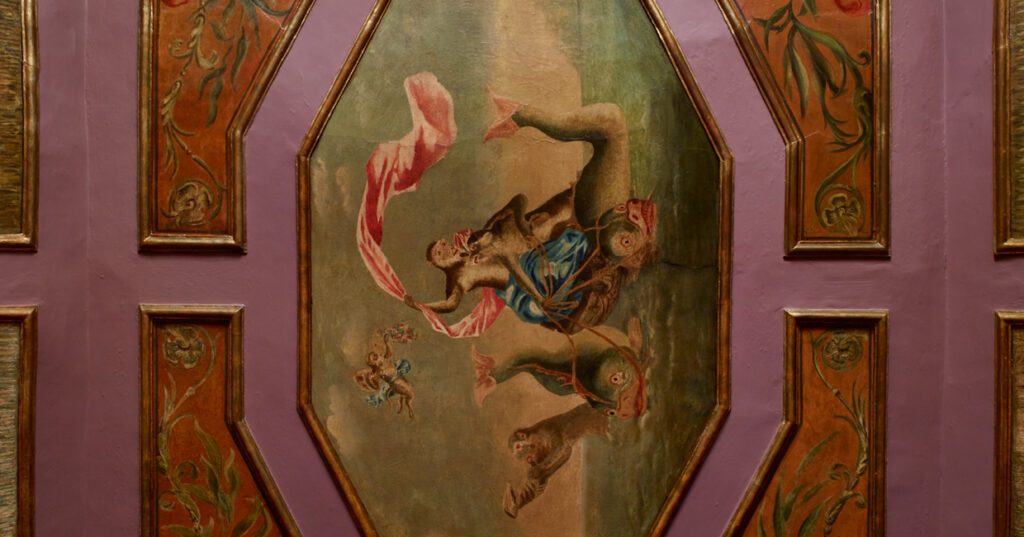
Another possible root of the name lies in the delightful depictions of monkeys undertaking various fishing and hunting pursuits – commissioned from French specialist, Andie de Clermont – that adorn the ceiling of the Pavilion’s ‘Monkey Room’.
However it came by its title, the estate’s rich tapestry of patrons have each left their mark and, in kind, the estate has made an indelible impression on the stream of monarchs, celebrities and creatives it has played host to over the years. Sir Edward Elgar is said to have worked on his First Symphony Violin Concerto in The Hut, a house on the adjacent bank, while literary great, Rebecca West centred her 1918 novel, The Return of the Soldier, on a past affair on Monkey Island.
Champalimaud Design has wholeheartedly embraced this storied past, retaining original features wherever possible, and embellishing on these narrative threads without creating jarring or disingenous elements.
“Sir Edward Elgar is said to have worked on his First Symphony Violin Concerto in The Hut, while literary great, Rebecca West centred her 1918 novel, The Return of the Soldier, on a past affair on Monkey Island”
“Our design is very much a celebration and a tribute to the storied history of the island,” affirms Jon Kastl, a Partner at Champalimaud. “We’ve looked to the two original structures on the island, the Temple and Pavilion buildings, which were constructed by Charles Spencer, 3rd Duke of Marlborough in the late 1730s, as inspiration for design vocabulary, but more importantly their innate joyfulness.
“The buildings were built as wonderful follies, beautiful decoration on this island setting. Large garden ornaments if you will, whose architecture and whimsy was much more important than their original purpose of fishing lodge and fishing temple.
“We’ve also celebrated the lore and anecdotal history of the island and some of its inhabitants, both human and otherwise. Of course the famed Andieu de Clermont paintings of the monkeys are being retained and lovingly restored. Inspired by their whimsy we’ve introduced animals, birds and other exotic birds into our designs, giving the monkeys some much needed friends.”
The splendour of the estate’s seven-acre grounds is never far from sight, both literally due to a series of architectural interventions, and metaphorically through the abundant natural imagery incorporated within the interiors. The Pavilion Room, for example, has been converted into a lattice-covered conservatory, while the lounge and restaurant have been extended into the adjacent terraces and gardens.
Upon arriving, guests are welcomed into the residential-style entry hall, complete with a striking wallcovering depicting graceful palm tree fronds. This naturalistic imagery continues in the Monkey Lounge and Bar, where the upholstery fabrics pay tribute to the monkey’s crimson and blue knee length coats in Andieu de Clermont’s Singerie paintings.
Within the Monkey Island Brasserie, the vibrant peacock blue wallpaper and Renaissance vaulted ceiling pay tribute to the flock of peacocks that formerly made their home at Monkey Island. These graceful birds are found, too, in the bespoke wallpaper of the hotel’s Garden Room.
A well-kept secret staircase, meanwhile, leads to the intimate enclave of the Whisky Snug. Nestled above The Monkey Room, this whimsical attic room features a bold statement wallpaper depicting an assortment of flora fauna, complete with a vibrant red patterned carpet. This charming retreat, with its spirited decor, is a fitting tribute to Charles Spencer himself.
The hotel’s beautifully-appointed accommodation extends these natural motifs, but also references the boats lazily making their way down the River Thames. “We’ve been inspired by the cabins of river boats and have developed bespoke amenities and storage cabinets which would feel very much at home on the Thames,” Jon explains. “The furnishings are spirited takes on British classics.”
Champalimaud opted for a palette of comforting warm greys, deep blues and caramels for the hotel’s 27 guest rooms and three deluxe suites. The accommodation is divided into four room types – The Barn Room, The Temple Room, The Temple Terrace and the magnificent Wedgewood Suite.
The standard rooms offer a contemporary English country house feel, and have been custom furnished throughout. Champalimaud has enlarged the marble guest bathrooms, too, creating a fresh, spa-like feel.
The pièce de résistance of the guest accommodation is the Temple Building’s Wedgewood Suite, which has now been fully restored. Complete with a master bedroom, separate seating area, dressing room and en-suite bathroom, this Grade One Listed suite is truly something to behold.
Its iconic ceiling has remained the signature Wedgewood blue, but has been carefully restored and decorated with contrasting white plasterwork. The panelled walls and wooden flooring, too, have been given some love and attention, while the contemporary bathroom and dressing room are luxurious new additions.
Perhaps the hotel’s most unusual attribute is its Floating Spa. Housed within a bespoke crafted barge on the river, the spa comprises three treatment rooms, an airy wheelhouse reception and an Elixir Bar – serving up ancient herbal tonics originally brewed by monks.
The key to this project’s success lies in Champalimaud’s considered approach to preserving that which should be preserved, and adding only meaningful new elements that both honour the heritage of the property and enrich the guest experience. Fundamental, too, is the obvious affection the team has for the estate, quirks and all.
“It is unimaginable for someone not to be charmed by the history and uniqueness of Monkey Island,” says John. “To spend an afternoon, an evening or a holiday on an island in the River Thames is special enough; but when you add in the storied history, the charming anecdotes, and of course the surrounding area, Monkey Island becomes even more unique and important.”