

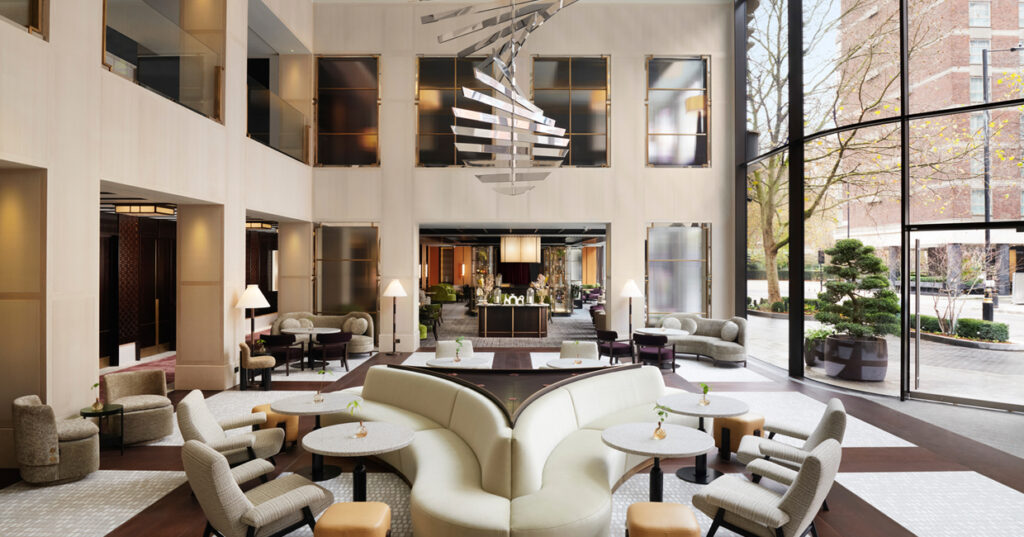

Photography by Jack Hardy
London’s second Nobu Hotel has opened its doors in Portman Square, complete with an unmissable 470m2 restaurant. Japanese architectural disciplines and minimalist design filter through both the public and event spaces by David Collins Studio, and the guest accommodation by Make Architects.
The Nobu phenomenon arrived on Park Lane in 1997, introducing Londoners to blond wood, black cod and a shout of “irasshaimase!” to welcome every guest. However, it was the launch of the Berkeley Street follow-up in 2005, with its flashbulb-popping jostle of paparazzi outside and table-hopping scene of celebrities within, that cemented Nobu’s reputation as the Japanese restaurant that was as hot as a slice of jalapaño.
Nobu Berkeley Street shut its doors in early 2020 after a sell-out 15-year run. “I get distraught when something closes before it’s had its full life,” admits Simon Rawlings, creative director of David Collins Studio, which was behind the iconic Berkeley Street design. “Of course it’s sad that Nobu Berkeley Street closed, but it had a lot of people through its doors and was a huge success. Now it’s time for something new, which is how it should be.”
That something new is Nobu Hotel London Portman Square, where the restaurant is explicitly billed as the continuation of Nobu Berkeley Street. David Collins Studio has designed the public areas of the 249-room hotel, including the lobby, lounge, terrace, boardrooms and ballroom, as well as the Nobu Bar and Restaurant.
“I remember sitting down with David [Collins] and coming up with the idea of a restaurant without corners or straight lines. From the outset, we decided that the whole restaurant would be inspired by nature”
The new property, which is just north of Oxford Street and borders Marylebone Village, is the third collaboration between L+R Hotels and Nobu Hospitality, and the 13th hotel for the global brand.
It is also the second Nobu Hotel in the UK capital after the Nobu Hotel London Shoreditch, which opened in 2017. While the concrete-and-terracotta look of Shoreditch reflects the edgy vibe of its East London locale, Nobu Hospitality was keen to resurrect the high-octane glamour of Nobu Berkeley Street for its new West End project – which meant that David Collins Studio was the natural designer to turn to.
This is no retread of the Mayfair restaurant, however – just as Nobu Berkeley Street was unrecognisable from anything that David Collins Studio had designed before. “We always try not to repeat ourselves, and to do something that feels like it’s evolving and different every time,” says Simon.
The studio had just finished working on The Wolseley – still its most enduringly iconic restaurant interior – when it was approached to work on Nobu Berkeley Street. While The Wolseley is all Mitteleuropean-esque dark woods and marble, there was no mistaking that Nobu Berkeley Street, with its aesthetic of zen minimalism and acres of pale wood, was a modern Japanese restaurant – albeit of a kind that London had never seen before.
“I remember sitting down with David [Collins] and coming up with the idea of a restaurant without corners or straight lines,” says Simon. “From the outset, we decided that the whole restaurant would be inspired by nature.” That meant a voluptuously curved downstairs bar with a Japanese-inspired tree as its centrepiece, and columns of titanium tree trunks growing through the two-floor site. “There was a lovely contradiction between nature and pure form,” says Simon.
“I think people today expect an intimate vibe from a cocktail bar. We really wanted to switch the mood over from the hotel experience to the Nobu experience”
It still looked unmistakably like a Nobu – which is to say a big, convivial and almost canteen-like space, alive with social hustle-bustle. “Each Nobu has some consistent elements,” Simon explains, “but pretty much everything else is specific to each location. Nobu Park Lane is about being quiet and ordered, whereas Berkeley Street was all about music and a lively dining experience, so it had to look very different.”
Nobu Portman Square is another convivial, canteen-like space, but with the immediately noticeable difference of dark tabletops. This is not just to pass what Simon calls the ‘soy sauce test’ – “making sure that any material we use doesn’t stain” – but is also to ensure that the modern Japanese cuisine is presented to best effect.
“We don’t do dark tabletops particularly often”, he says. “But I feel that because a lot of Nobu’s food is on the lighter end of the spectrum – pink tunas and pale white fish, rather than brown meats and rich sauces – I wanted it to be contrasted against these dark tabletops.”
Those tabletops are made from a linseed linoleum, which is not only practical – it is both durable and recyclable – but also tactile. “What’s lovely about it is that it’s soft to the touch,” says Simon. “It’s not like having a marble tabletop. It almost replicates the softness of a tablecloth, which I really like.”
“The hotel’s rooms and suites echo the distinct character and allure seen within the rest of the property, primarily influenced by a Japanese minimalist aesthetic and complemented by moments of bold artistic expression”
The dining room is not the only place where a darker-than-expected colour palette can be found. The inspiration for the bar, says Simon, was a Japanese indigo dye, which gives the room the feel of being saturated with juicy colour. Deep blue raku tiles line a corner space that feels like a sexy and secretive hiding space from Portman Square outside.
“With the bar being on such an exposed corner, I wanted it to feel very closeted and cosy,” says Simon. “I think people today expect an intimate vibe from a cocktail bar. We really wanted to switch the mood over from the hotel experience to the Nobu experience.”
He also admits that the new bar is a step up in sophistication from Nobu Berkeley Street: “Ultimately, I think what people really want from a bar is a mood. If you get that right, everything else falls into place. Berkeley Street was very showy and was the beginning of an explosion of ginormous, glitzy restaurants in that part of Mayfair. I think we have all grown up since then. There are beautiful little details in the bar at Portman Square, such as the Japanese paper on the lamps. But I think people will love it for the overall feeling rather than the individual elements.”
The terrace and the lobby lounge, meanwhile, offer an altogether different feeling to the bar and restaurant. “If you’re staying as a hotel guest, you want to have a few different experiences,” says Simon. “You might want to have breakfast in a different space to your dinner. But the lobby is also a real destination that is separate to the Nobu experience. I wanted to create something that had a lovely buzz of warmth and energy, as well as being somewhere you could use regularly if you live locally. It’s all about trying to capture the imagination of different types of customers.”
The 340m2 lobby features a palette of warm naturals and grey tones, with geometric flooring in timber and terrazzo, and walls wrapped in Japanese-inspired faux orange silk.
“The Nobu Hotel lobby vision extends into a Japanese silk-lined lounge,” explains Simon. “Glass towers anchor the room and ground the polished wood-canopied ceiling. All-day comfort and approachable glamour embody the space. Shimmering textures and rippled raku leave surfaces drenched in patination – instantly rich and warm.”
The hotel’s rooms and suites echo the distinct character and allure seen within the rest of the property, primarily influenced by a Japanese minimalist aesthetic, and complemented by moments of bold artistic expression.
Striking wall prints, bespoke lighting, plush Newhey carpets and intricate joinery take centre stage in each room, set against the backdrop of a neutral, textural colour palette. An abundance of natural light and natural materials create a sense of place that is calm, bright and warm.
Art plays a fundamental role in creating the hotel’s distinct identity. “I call it integrated art,” says Simon. “The art was part and parcel of the vision from day one. I knew from the minute that I saw Ivan Black’s work that I wanted to work with him on this.” Black’s contribution is a 5m kinetic sculpture that casts a spectacle of light and shade from its rotating metal fins. “It spins on its own momentum and is just incredibly elegant. It transforms a monumental double-height lobby space into somewhere very calming.”
Elsewhere, a Jeremy Maxwell hand-blown glass cloud illuminated sculpture hangs over the hotel reception and a carved wood chandelier by South African artist David Cramer fills the ceiling of the bar, while three works by French artist Pierre Bonnefille sit in the reception.
“We could have opened the Japanese architecture book for this project, but that’s not what it’s about,” says Simon. “We touch on Japanese design through small, sensitive things and subtle references, and reinvent them in a way so that they sit at ease within the building. We have drawn inspiration from Japanese textures such as cracked glass, polished woods and timber panelling, but I would love to think that we reinvented them enough so that they don’t feel typically Japanese. For me, it’s all about the exquisiteness of the detail and the refinements. Nobu is an incredible brand and it is a lifestyle. Ultimately, the Japanese references are on the plate.”
True enough. But with the Nobu Hotel London Portman Square, David Collins Studio has designed a lifestyle that London will eat up.