


By Alex Duncan, Director of Interiors JPA DesignLondon
One of the recurring themes at hospitality shows and conferences is what the Hotel of the Future will be like. On occasion actual mock-up guest rooms have been fabricated to demonstrate the kinds of environments we can expect to see in years to come.
These events and exercises are always fascinating and thought provoking but do tend to generate as many questions as they give answers. I suspect this is because no one can really predict with certainty what is likely to happen.
Given the increasing numbers of targeted brands, imaginative developers, independents and formula-based rollouts together with the continued attractions and benefits of the major hotel groups, in reality there will be a wide range of Hotels of the Future.
At the luxury end of the market, there seems to be some consensus that hotels will be more restrained and less lavish in style, provide more home from home, authentic tailored experiences and will connect more closely to their locations and respond to environmental concerns while, where appropriate, focussing on speciality F&B outlets that are accessible from the street with all day dining perhaps relegated to a secondary role to take up much less of the valuable space available.
At the same time, the whole welcome experience is increasingly critical in setting the tone for the entire hotel while delivering exceptional wellness experiences will continue to rise as a crucial differentiator.
Some of our most recent briefs for high-end city centre hotels have been very much focussed on these characteristics and I can imagine this approach is likely to continue in certain cases given that the economic uncertainties, environmental issues, changing values and social mobility that have helped create this trend could remain with us for some time.
Interestingly many of the resorts in APAC that we have designed over the years could also fit this description because the small-scale accommodation structures are necessarily modest in scale and complexity, environmental issues are critical and the vernacular architectures, which always inform our work in these cases, tend to be beautifully pure, crafted and authentic.
But at the same time we are still engaged on projects within landmark buildings that have existing lavish interiors, which we must acknowledge and sensitively enhance. There is also increasing demand for unique experiences that guests can share through various media. Creating spaces that catch the imagination in this way to some extent defies the move towards more simple and modest environments.
“At the lower cost end of the market there is of course the rise in no-nonsense, space-efficient and systemised experiences that almost tear up the rule books”
At the lower cost end of the market there is of course the rise in no-nonsense, space-efficient and systemised experiences that almost tear up the rule books by ignoring for example the need for windows, human interaction or any F&B offer other than by vending machines.
Some of these operations can and do benefit from modularised, pre-fabricated construction and fit-out techniques, which are often used as examples of the future. To some extent this is true but it cannot be viewed as a panacea that is suitable for all hotel types.
As has been well documented it is the mid-level hotel that seems to have a relatively unclear future. Should it push towards a more luxurious version of budget hotels and rely on superior F&B offers and amenities or should it pare everything back and rely on superior room size and levels of service to justify the higher rates? This potential lack of identity in an increasingly identity driven world could result in failures in this band.
On a recent project of this nature we have been working on a mid level hotel where the design enables an injection of vibrancy and adaptability. For example, this has involved collaborations with the local arts scene so that the lobby can be used for installations, exhibitions, performances, pop-up shops or specialist food stalls while the welcome experience and facilities within the rooms and tailored apps enable guests to engage with other guests (past, present and future) and the locations within the city to discover local events, attractions and services.
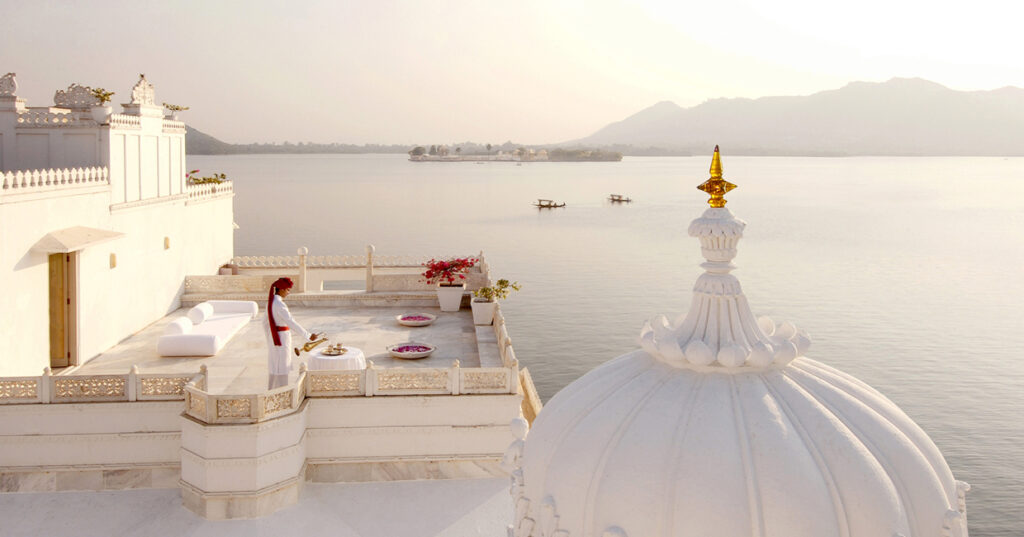
“Some of the new luxury projects we are involved in are new-builds with cool, contemporary interiors while others like the Lake Palace in Udaipur are located in iconic former palaces, which require a very different creative mindset to ensure successful results”
Whatever the type of hotel, we are likely to see significant increase in demand in the tourist market in UK. Despite the economic climate, visitor numbers to major destinations continue to grow all around the country and, for example, the potentially huge Asian market has been hardly tapped into yet.
So far tourists from China are not nearly as evident in the UK as they are at tourist hot spots elsewhere in Europe, whilst the Indian market has virtually no noticeable presence here yet.
It is not unrealistic to imagine that should the economies of China and India continue to boom and visa controls are relaxed vast numbers of visitors could arrive in UK from these locations. Not unreasonably there would then be an expectation that hotels to some degree cater to their tastes and preferences. How long will it be for example before our hotels will have to offer noodles or dosas alongside the traditional English breakfast?
In both of these countries the speed of growth in domestic and international tourism is impressive and no doubt like other hotel design specialists, our portfolio of work in the region continues to expand.
Some of the latest luxury projects we are involved in are new-builds with cool, contemporary interiors while others like the Lake Palace in Udaipur are located in iconic former palaces, which require a very different creative mindset to ensure successful results.
Equally there is a relatively under exploited opportunity in India and China to set up smart, clean, modern, reasonably priced operations catering to professionals and leisure travellers on relatively tight budgets.
Flat pack or capsule pre-fabricated construction techniques where standards are guaranteed and speed of construction considerably improved, would seem to be a perfect approach in these cases provided supporting infrastructure issues can be resolved.
So whether in UK or Asia it seems that the multi-facetted hotel market will continue to spawn exceptional creative solutions to cater for the multiplicity of different guest types, values, locations, conditions, cultural shifts, buildings and opportunities.
Modern technologies will be integrated where appropriate, automated and personalised service will co-exist, and debates will rage about the next big thing. The beauty of it all is that there is no right or wrong and although there will inevitably be difficult periods and casualties, provided all involved embrace change while not ignoring lessons and best examples from the past this amazing industry will continue to flourish.