

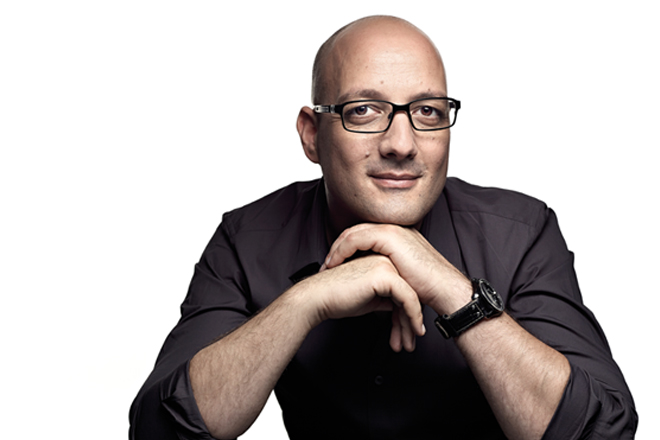

Davide Oppizzi founded DCUBE – a multi-disciplinary Swiss company specialising in the creation and development of high-end projects involving lighting, design, greentech and architecture – in 2001. Hospitality Interiors spoke with Davide to find out more about his design inspiration, his innovative creations combining light and water, and the use of lighting in hospitality environments as a whole …
How did you forge a career in the industry, and what was it that first drew you to the world of design?Ӭ Ҭ
I am a designer of decorative arts, where the integration of materials and technology is crucial. Designers cannot survive with just wonderful ideas and drawings – we are also clearly dependent on materials. It is often the discovery of a manufacturer or a specific material that stimulates our creative possibilities. Similarly, manufacturing processes often guide how we develop a design idea. As far as I can remember, my first building design was inspired by the Geneva Opera.
From the DCUBE studio, which was established in 2001, our first industrialised product was the Micro-LED lamp “Eclipse.” Since its introduction, we have produced over 150,000 copies by DGA in Italy. It has been installed by some of the biggest brands, including Chanel, Mont Blanc, Hublot, Baume & Mercier, Patek Philippe, etc.
The idea for this lamp came to me on a trip when I met a friend who had a hand in creating the first market power LEDs. Incorporating it was not an easy task because we wanted the lamp to be very thin and small. In the product development process, manufacturers and designers have to communicate and collaborate efficiently to create something unique.
“Often inspired by nature, my mission is to share my feelings and creative sensibility with my students and the world. I inject love in the material until it carries my vision”
Who was inspirational to you early on in your career, and why?Ӭ Ҭ
To tell you what inspired my career is not so simple. As far as I can remember I have always been fascinated by architects like Frank Lloyd Wright. His processes, vision and precise way of working has always inspired me. I also remember being greatly affected by the sculptor Alberto Giacometti. The finesse and depth of expression of his sculptures left a huge mark on me.
My first film was Space Odyssey in 2001; I was only 12 and astounded by the universe created by Stanley Kubrick. The movie was a glimpse into the future, a real mastery of space and time and an opening to the unlimited nature of the universe.
Additionally, I am greatly inspired by Eastern cultures, specifically the work of Hokusai Japanese. I’m also currently inspired by contemporary designers like Marcel Wanders (Moooi), Konstantin Grcic, Atelier Oi, Ross Lovegroove, and Patricia Urquiola.
What inspires you, personally, in your work? Ҭ
Inspiration comes when we open our eyes in life! All life, including nature, society, philosophy and technology. A trend is created out of the challenges found in the present.
We live in an era where almost everything is possible and that access to the world is both our opportunity and our challenge. Having an unlimited vision provides you with constant inspiration without much effort.
And of course we must be able to master the current tools such as 3D printing and other contemporary tools that can materialise the idea. But, do not forget, all of the “DNA” of my ideas come from my pen in small sketchbooks.
What would you say are the defining philosophies of DCUBE?Ӭ Ҭ
Our style is inspired by an industrial design that incorporates innovative materials and a minimal ecological footprint. Often inspired by nature, my mission is to share my feelings and creative sensibility with my students and the world. I inject love in the material until it carries my vision.
Obviously you have a multidisciplinary approach, but what is it about designing with water that interests or attracts you?
Humbly, when I was asked to draw GRAFF’s Ametis collection, I didn’t even know how hot and cold water got mixed within a water system. And it is this continuous learning experience that excites me. Discovering the world of water and working without any experience has forced me to be innovative in the collections’ development process.
“Humbly, when I was asked to draw GRAFF’s Ametis collection, I didn’t even know how hot and cold water got mixed within a water system. And it is this continuous learning experience that excites me”
Could you please tell me more about what you wanted to achieve through combining light and water for the Ametis collection?
GRAFF’s Ametis shower is designed to have as little material as possible, including the LED light ring, which provides additional comfort in the space of the bathroom. The soft, indirect light creates a unique atmosphere. The first models incorporating lighting were designed for chromotherapy, with the full RGB spectrum that can be adjusted according to our mood.
The idea was also to associate the hot white light to avoid having to add more space in the shower. Often light in the bathroom is fairly raw and hard, because it comes either from the ceiling or the mirror. Indirect light creates a much softer light that is much more comforting and warm.
Do you feel – broadly speaking – that there has been a shift or movement in the use of lighting within hospitality environments?
There is a lot of change happening now with the contribution of new LED technologies because the architecture of miniaturised components can create countless opportunities for integration. However, I feel it shouldn’t be overused. An excessive use of LED lights may saturate the eye and eliminate the perception of matter.
After more than 15 years working in LED technology, we can clearly say that we come again to the shades of warm white light because we are totally tired of colours like RGB, which should be used sparingly in projects.
Could you please tell me more about what you wanted to achieve through combining light and water for the Ametis collection?
GRAFF’s Ametis shower is designed to have as little material as possible, including the LED light ring, which provides additional comfort in the space of the bathroom. The soft, indirect light creates a unique atmosphere. The first models incorporating lighting were designed for chromotherapy, with the full RGB spectrum that can be adjusted according to our mood.
The idea was also to associate the hot white light to avoid having to add more space in the shower. Often light in the bathroom is fairly raw and hard, because it comes either from the ceiling or the mirror. Indirect light creates a much softer light that is much more comforting and warm.
Do you feel – broadly speaking – that there has been a shift or movement in the use of lighting within hospitality environments?
There is a lot of change happening now with the contribution of new LED technologies because the architecture of miniaturised components can create countless opportunities for integration. However, I feel it shouldn’t be overused. An excessive use of LED lights may saturate the eye and eliminate the perception of matter.
After more than 15 years working in LED technology, we can clearly say that we come again to the shades of warm white light because we are totally tired of colours like RGB, which should be used sparingly in projects.
Have you got any upcoming hospitality projects in the pipeline that you’re able to share with us?”¨
I’m working on a lot of projects, I won’t be able to tell you about all of them. On the industrial design side we will be presenting a new collection in January at Maison & Objet 2016 in Paris. The new collection consists of desk lamps that feature organic and plant-like forms. The 2NIGHTS collection was created for LineaLight and is also complemented by a magnificent choice of finishes – it will be on view at Light & Building in Frankfurt.
We will also release a collection of small Tribales lamps made with lava stone from Bali-Java. It is a DCUBE-designed project using filament LED bulbs.
On the architectural light side, we are working on projects for big jewellers in London and Geneva, luxury apartments in London, as well as new bathroom furniture projects .I’m working on a lot of projects, I won’t be able to tell you about all of them. On the industrial design side we will be presenting a new collection in January at Maison & Objet 2016 in Paris. The new collection consists of desk lamps that feature organic and plant-like forms. The 2NIGHTS collection was created for LineaLight and is also complemented by a magnificent choice of finishes – it will be on view at Light & Building in Frankfurt.
We will also release a collection of small Tribales lamps made with lava stone from Bali-Java. It is a DCUBE-designed project using filament LED bulbs.
On the architectural light side, we are working on projects for big jewellers in London and Geneva, luxury apartments in London, as well as new bathroom furniture projects .