

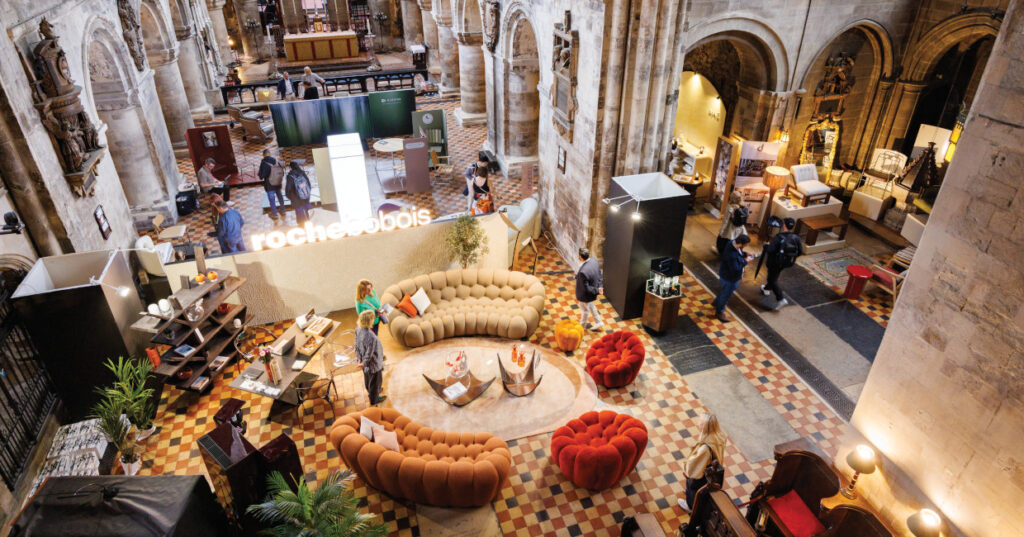

Clerkenwell Design Week returns to London from 19–21 May 2026 with its most ambitious edition yet, marking 15 years of the festival by transforming EC1 into a continuous field of interiors, installations and public design interventions where Europe’s leading design cultures meet in the streets, gardens and historic buildings of the district.
Clerkenwell Design Week (CDW) has always been shaped by its setting, but in 2026 the relationship between design and place becomes more deliberate. Rather than occupying spaces temporarily, the festival increasingly constructs them. Across EC1, buildings, courtyards and streets are reimagined as interior environments, while public areas become stages for experimentation.
At the centre of this year’s edition is a dual focus: a programme of large-scale Design Interventions across the public realm, and an expanded international showcase of European design cultures presented through immersive installations and curated environments.
Together, they position Clerkenwell not as a backdrop for design, but as part of its expression.
The Design Interventions programme introduces a series of works that embed design directly into the fabric of the district. On Clerkenwell Green, a sculptural terrazzo installation explores how colour is perceived differently depending on visual sensitivity, turning a material typically associated with flooring into a spatial and social experience. The work encourages visitors to consider inclusivity not as an add-on to design, but as something embedded within its physical structure. Colour here becomes navigational as well as aesthetic, shaping movement through the installation.
Outside St James’ Church, a series of curved stone seating elements reinterprets traditional English landscape forms. Inspired by serpentine garden walls, the installation translates agricultural geometry into public furniture, creating a sculptural rhythm across the street. The benches function both as infrastructure and object, blurring the distinction between landscape and interior logic.
Elsewhere, outside Haberdashers’ Hall, a living installation introduces time as a material in its own right. Structured as two opposing forms embedded with seeds, the work evolves over the course of the festival as natural growth begins to alter its surface. What begins as a constructed object gradually shifts towards something more organic, challenging the idea that design is ever fixed. Instead, it is presented as a process that continues beyond completion.
Haberdashers’ Hall itself becomes a central venue for the festival, hosting the expanded design awards programme alongside installations and exhibitions. The awards now recognise not only products across furniture, lighting and materials, but also the broader thinking behind design direction and collaboration. The building becomes a point of reflection within the festival’s wider landscape, where industry and public programme intersect.
Across EC1, Clerkenwell’s historic architecture continues to play a defining role. A medieval church once again becomes a space for dialogue and installation, where a large suspended structure draws on folded geometric forms to create a complex overhead presence within the stone interior. Beneath it, a programme of talks and discussions curated by PR and cultural consultants brings together designers, architects and thinkers to explore how design relates to culture, material and technology. The space functions simultaneously as installation and forum, reinforcing the festival’s focus on design as conversation as well as object.
Lighting takes centre stage in a former institutional building that becomes a dedicated exhibition space. Here, a large-scale installation explores the relationship between illumination, shadow and digital fabrication. The work shifts in appearance depending on light and movement, turning lighting into an environmental condition rather than a fixed object. It reinforces a broader theme across the festival: design is increasingly understood as something experienced in motion rather than viewed statically.
Alongside these interventions, the international exhibition programme brings a strong European presence to EC1, turning the district into a temporary atlas of design cultures.
Spain presents one of the most expansive contributions, transforming a historic museum space into an immersive interior installation. Within this environment, furniture, lighting and material systems are arranged as part of a single spatial narrative rather than separate displays. Objects function together to form a complete interior experience, reflecting a design approach where architecture, product and surface are closely connected. A second installation extends this thinking outdoors, where ceramics are used to construct a structured garden environment inspired by seasonal change and literary references. Here, materials traditionally associated with surfaces are reinterpreted as spatial and architectural elements.
Italy presents a more formal interpretation of interior space, focusing on hospitality as a complete environment. Within a historic hall, a curated installation brings together furniture, lighting and bathroom systems arranged into a calm, unified interior. The emphasis is on balance and restraint, with a limited palette of tones and materials creating a coherent spatial experience. Across additional venues, Italian design is extended through further presentations of surfaces, seating and lighting, reinforcing a consistent approach to interior composition. The Italian presence across EC1 also continues through showroom activations, expanding the festival beyond curated spaces into the wider district.
Norway introduces a quieter, more reflective perspective within a cloister setting, where a bedroom environment is constructed around ideas of comfort and material honesty. Mid-century inspired furniture is paired with natural stone and soft textile elements, creating a space defined by temperature, texture and calm rather than visual complexity. The installation focuses on how interiors can support rest, positioning simplicity as a form of design intent.
Germany presents a contrasting approach focused on systems, performance and technical precision. Within a dedicated venue, flooring, kitchen systems, textiles and workplace solutions highlight durability and function. Furniture systems are designed for adaptability and long-term use, reflecting a design culture that prioritises structure and efficiency. The presentation emphasises interiors as frameworks that support activity rather than purely aesthetic environments.
Austria contributes a material-led installation focused on craftsmanship and natural resources. Timber, lighting and furniture are presented with an emphasis on traditional making processes and material clarity. The work highlights texture, proportion and longevity, reinforcing a restrained approach where design is expressed through material rather than ornament.
The United Kingdom’s presence is anchored in a long-standing church venue, where established and emerging designers present furniture and seating that explore comfort, sustainability and adaptability. Alongside this, experimental work focuses on reuse and material transformation, with installations that reinterpret waste into new forms of furniture and prototype systems. Across EC1, additional British showrooms introduce new collections that reflect ongoing interest in circularity, domesticity and material innovation.
What emerges across Clerkenwell Design Week 2026 is a clear shift in how design is presented and experienced. Installations increasingly function as environments rather than displays, while materials are used to construct atmosphere rather than simply surface. Furniture, lighting and architecture are no longer separated categories, but part of a continuous spatial language.
At its core, the festival reflects a broader change in design thinking. Interiors are no longer defined only by objects, but by how those objects shape movement, interaction and perception. Whether through evolving installations, structured gardens or immersive rooms, design is presented as something lived within rather than observed from a distance.
As EC1 transforms over three days in May, the district becomes a layered interior landscape. Streets act as corridors, historic buildings become rooms, and public spaces turn into points of gathering and pause. Design is not simply shown in Clerkenwell. It is built into it, and briefly, the city becomes the interior itself.